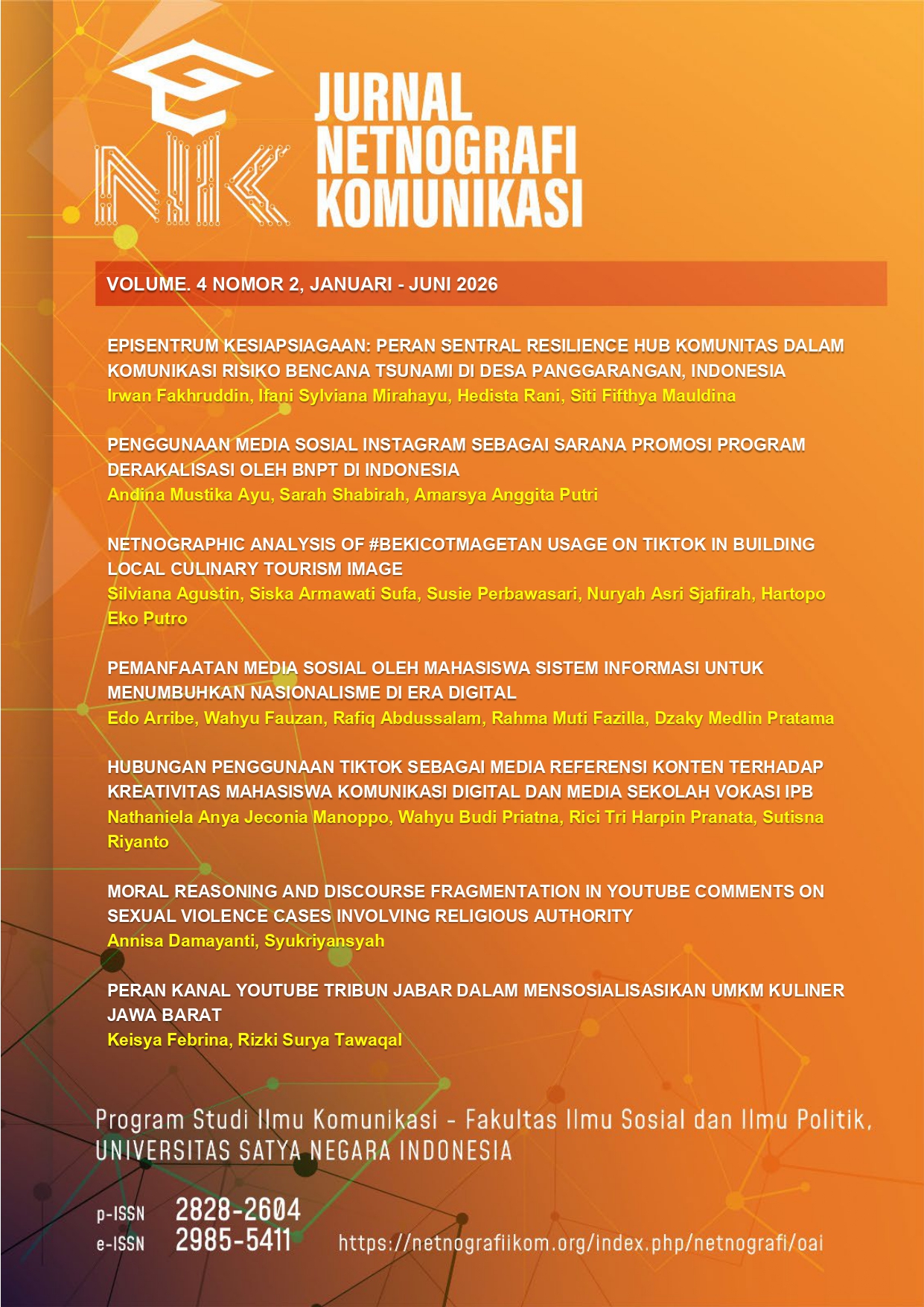
EPISENTRUM KESIAPSIAGAAN: PERAN SENTRAL RESILIENCE HUB KOMUNITAS DALAM KOMUNIKASI RISIKO BENCANA TSUNAMI DI DESA PANGGARANGAN, INDONESIA
DOI:
https://doi.org/10.59408/jnk.v4i2.110Keywords:
CBDRM, komunikasi risiko bencana, pusat ketangguhan , ruang edukasi, netnografi, media sosialAbstract
Indonesia's geographical position exposes it to high vulnerability to geological and hydrometeorological disasters, demanding a solid disaster risk reduction (DRR) framework. The disaster management paradigm is now shifting from a merely reactive response towards proactive resilience-building. Disaster risk education is a key element in this transition; however, many initiatives are still top-down and often neglect the vital role of community-owned spaces. This article investigates the function of educational space as critical infrastructure for disaster risk communication in Panggarangan Village, Banten, the first village in its province to achieve the ‘Tsunami Ready Community’ recognition from UNESCO-IOC. Employing a qualitative-observatory case study method, this research maps the interaction between actors, various activities, and the spaces that accommodate disaster education activities. The main findings indicate a pentahelix collaboration model significantly dominated by community actors, particularly the South Lebak Mitigation Group (GMLS). The key to their success rests on the existence of a ‘resilience hub’—namely the GMLS Command Center in the Villa Hejo Kiarapayung area—which serves as the primary location for the majority of educational activities. This research concludes that there is a strong consistency between the central role of community actors and the availability of a dedicated and easily accessible resilience hub. The success of Panggarangan suggests that the provision of community-centered spaces is a crucial—and often overlooked—factor in creating sustainable community-based disaster risk management (CBDRM).
Keywords: Community-Based Disaster Risk Management (CBDRM), Disaster Risk Communication, Resilience Hub, Educational Space, Tsunami Preparedness.
References
Abah Lala. (2023). Gugus Mitigasi Lebak Selatan: What We Have Been Doing. Lebak.
Aisah, S., & Nursatyo. (2024). RAGAM BENTUK PEMANFAATAN MEDIA SOSIAL OLEH SITUS BERITA ONLINE. Jurnal Netnografi Komunikasi, 2(2), 42–56. https://doi.org/10.59408/jnk.v2i2.23
Aleksandrova, M., et al. (2021). World Risk Report 2021.
Asharose, Saizen, I., & Chakkalathundiyil, P. K. S. (2015). Awareness Workshop as an Effective Tool and Approach for Education in Disaster Risk Reduction: A Case Study from Tamil Nadu, India. Sustainability, 7, 8965–8984.
Andina Mustika Ayu, & Karlinda Dewi Anggraini. (2023). Film Aquaman Sebagai Media Kampanye Kesadaran Lingkungan Global. Jurnal Netnografi Komunikasi, 2(1), 19–26. https://doi.org/10.59408/netnografi.v2i1.15
Ayuningtyas, D., Windiarti, S., Hadi, M. S., Fasrini, U. U., & Barinda, S. (2021). Disaster Preparedness and Mitigation in Indonesia: A Narrative Review. Iran J Public Heal., 50(8), 1536–1546.
Badan Pusat Statistik Kabupaten Lebak. (2021). Kecamatan Panggarangan dalam Angka 2020. Lebak.
Baja, K. (2018). Resilience Hubs: Shifting Power to Communities and Increasing Community Capacity.
Briandana, R., Dwityas, N. A., Marta, R. F., Hesti, S., & Nurhayati, K. (2024). Pemanfaatan informasi polusi plastik pada media sosial terhadap perilaku konsumsi hijau Generasi Z. Warta Ikatan Sarjana Komunikasi Indonesia (Warta ISKI), 7(1). https://doi.org/10.25008/wartaiski.v7i1.283
CEF-DMAH. (2021). Indonesia Disaster Management Reference Handbook. Hawaii.
Ciriaco, T. G. M., & Wong, S. D. (2022). Review of Resilience Hubs and Associated Transportation Needs. Transp. Res. Interdiscip. Perspect., 16, 1–12.
Clark-Ginsberg, A., & Hunt, D. (2015). Disaster Risk Reduction for Community Resilience: A synthesis of lessons from more than a decade of Disaster Risk Reduction Programming. Dublin: Concern Worldwide.
Cutter, S. L., et al. (2008). Community and Regional Resilience: Perspectives from Hazards, Disasters, and Emergency Management. Geography, 1(7).
Disaster Management Cycle | UN-SPIDER Knowledge Portal. (n.d.). Diakses 16 Februari 2023, dari https://www.un-spider.org/glossary/disaster-management-cycle
Dufty, N. (2020). Disaster Education, Communication and Engagement. Wiley Blackwell.
Gavari-Starkie, E., Casado-Claro, M. F., & Navarro-González, I. (2021). The Japanese Educational System as an International Model for Urban Resilience. Int. J. Environ. Res. Public Heal. 2021, Vol. 18, Page 5794, 18(11), 5794.
Gugus Mitigasi Lebak Selatan (GMLS). (2022). Progres Capaian Kegiatan: 12 Indikator Masyarakat Siaga Tsunami Desa Panggarangan Kabupaten Lebak Banten. Lebak.
Gugus Mitigasi Lebak Selatan (GMLS). (2022). Rencana Operasi Kedaruratan Desa Panggarangan Kabupaten Lebak - Provinsi Banten. Panggarangan.
Hofer, J., et al. (2014). Report on Risk Perception.
IFRC / ARUP International. (2011). The Characteristics of a Safe and Resilient Community: Community Based Disaster Risk Reduction Study Development.
Islamic Development Bank (IsDB). (2020). Disaster Management and Resilience Policy. Jeddah: Blackwood Creative Ltd.
JANI (Joint Advocacy Network Initiative). (2011). Framework on Community Based Disaster Risk Management in Vietnam. Hanoi: JANI.
Johnson, V. A., Ronan, K. R., Johnston, D. M., & Peace, R. (2014). Evaluations of Disaster Education Programs for Children: A Methodological Review. Int. J. Disaster Risk Reduct., 9, 107–123.
Kawata, Y., Takenouchi, K., & Yamori, K. (2021). Education for Disaster Risk Reduction in Hyogo to Be Handed Down Through Generations. J. Disaster Res., 16(2), 244–249.
Khumairoh, Z., Widana, I. D. K. K., & Sumantri, S. H. (2021). The Role of Communication as the Disaster Risk Reduction in Indonesia Capital City Transference Policy. In IOP Conference Series: Earth and Environmental Science (Vol. 708, No. 1).
Lestari, P. (2018). Komunikasi Bencana: Aspek Penting Pengurangan Resiko Bencana. Yogyakarta: PT. Kanisius.
Luke, J., Franklin, R. C., Dyson, J., & Aitken, P. (2022). Building Toward A Disaster Resilient Health System: A Study of Hospital Resilience. Disaster Med. Public Health Prep., 17, 1–8.
Panić, M., Kovacevic-Majkic, J., Miljanovic, D., & Miletic, R. (2013). Importance of Natural Disaster Education. Case Study of the Earthquake near the City of Kraljevo: First results. J. Geogr. Inst. Jovan Cvijic, 63(1), 75–88.
Pemerintah Desa Panggarangan. (2023). Peta Desa Panggarangan. Lebak.
Rodriguez, H., Diaz, W., & Aguirre, B. (2004). Communicating Risk and Warning: An Integrated and Interdisplinary Research Approach. CWL Publ. Enterp. Inc., Madison, 2004.
Sawada, Y. (2007). The Impact of Natural and Manmade Disasters on Household Welfare. Agric. Econ., 37(S1), 59–73.
Sulianta, F. (2022). Netnografi: Metode Penelitian Etnografi Digital pada Masyarakat Modern. Yogyakarta: Andi.
Torani, S., Majd, P., Maroufi, S., Dowlati, M., & Sheikhi, R. (2019). The Importance of Education on Disasters and Emergencies: A Review Article. J. Educ. Health Promot., 8(1).
UNDRR. (2022). Disaster risk | UNDRR. Diakses 26 Oktober 2022, dari https://www.undrr.org/terminology/disaster-risk
UNDRR. (n.d.). Disaster Risk Communication | PreventionWeb. Diakses 30 Januari 2024, dari https://www.preventionweb.net/collections/disaster-risk-communication
Widyaningrum, N., Nurhadiyanti, A. P., & Widana, I. D. K. K. (2020). The Importance of Disaster Knowledge in Early Childhood for The Future Investment. Proceeding Int. Conf. Sci. Eng., 3, 605–609.
Wiguna, S., et al. (2021). Indeks Risiko Bencana Indonesia Tahun 2020. Badan Nasional Penanggulangan Bencana (BNPB).
Yeon, D. H., Chung, J. B., & Im, D. H. (2020). The Effects of Earthquake Experience on Disaster Education for Children and Teens. Int. J. Environ. Res. Public Health, 17(15), 1–14.
Yore, R., Kelmand, I., & Tofa, M. (2018). Community-based Disaster Risk Management (CBDRM).
Yusuf, R., Razali, Sanusi, Maimun, Fajri, I., & Gani, S. A. (2022). Disaster Education in Disaster-prone Schools: A Systematic Review. IOP Conf. Ser. Earth Environ. Sci., 1041(1).
Downloads
Published
How to Cite
Issue
Section
License
Copyright (c) 2025 Irwan Fakhruddin, Ifani Sylviana Mirahayu , Hedista Rani, Siti Fifthya Mauldina

This work is licensed under a Creative Commons Attribution-NonCommercial-ShareAlike 4.0 International License.