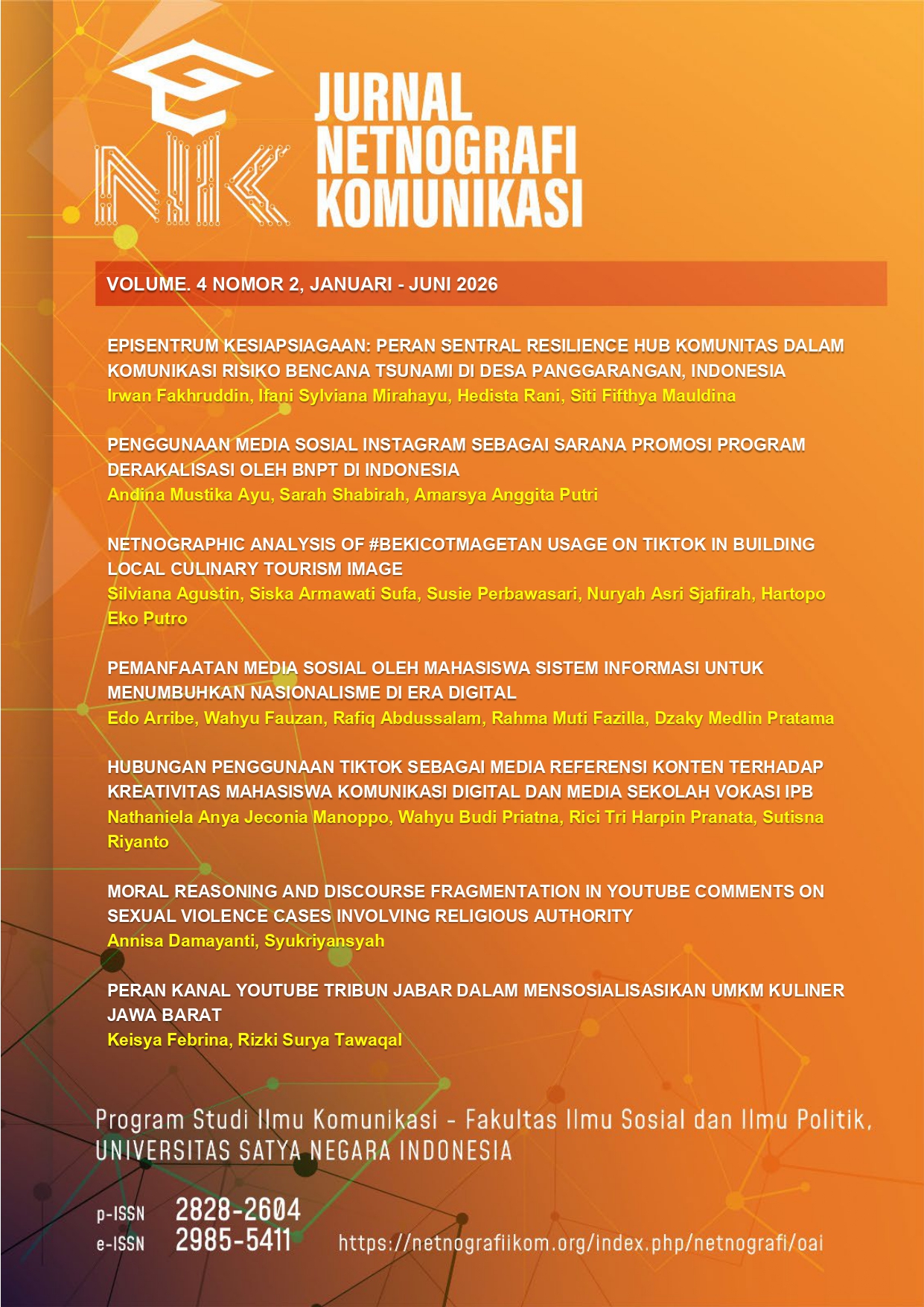
MORAL REASONING AND DISCOURSE FRAGMENTATION IN YOUTUBE COMMENTS ON SEXUAL VIOLENCE CASES INVOLVING RELIGIOUS AUTHORITY
DOI:
https://doi.org/10.59408/jnk.v4i2.124Keywords:
Digital Public Sphere, moral reasoning, social network analysis, religious Authority, Youtube commentAbstract
This study examines moral reasoning and discourse fragmentation within the YouTube comment section of a viral video detailing a case of sexual violence involving a religious authority figure in Indonesia. Employing a Mixed Methods Social Network Analysis (MMSNA) approach, we analyzed 6,018 comments from 5,484 users to map the network structure, identify communicative communities, and assess emotional polarization via sentiment analysis. Findings reveal a highly fragmented and sparse network with low user interactivity, dominated by isolated, small-scale communities. Despite this structural fragmentation, sentiment analysis showed a predominance of neutral expressions (76.9%), with limited emotional polarization between the six main thematic communities identified. These communities function as distinct "affective micro-publics," articulating responses through specific discursive roles: moral-religious condemnation, emotional support, social reflection, fear of stigma, digital activism, and social ethics critique. The study concludes that the digital discourse operates not as a unified deliberative space but as a constellation of value-aligned clusters, where morality and empathy, rather than rational debate, mediate public participation. This underscores the role of platform architecture in fostering affective enclaves around sensitive socio-religious issues.
References
Ahuja, V., & Shakeel, M. (2017). Twitter Presence of Jet Airways-Deriving Customer Insights Using Netnography and Wordclouds. Procedia Computer Science, 122, 17–24. https://doi.org/10.1016/j.procs.2017.11.336
Brady, W. J., Crockett, M. J., & Van Bavel, J. J. (2020). The MAD model of moral contagion: The role of motivation, attention, and design in the spread of moralized content online. Perspectives on Psychological Science, 15(4), 978–1010.
Chakraborty, K., Bhatia, S., Bhattacharyya, S., Platos, J., Bag, R., & Hassanien, A. E. (2020). Sentiment Analysis of COVID-19 tweets by Deep Learning Classifiers—A study to show how popularity is affecting accuracy in social media. Applied Soft Computing Journal, 97, 106754. https://doi.org/10.1016/j.asoc.2020.106754
Cinelli, M., De Francisci Morales, G., Galeazzi, A., Quattrociocchi, W., & Starnini, M. (2021). The echo chamber effect on social media. Proceedings of the National Academy of Sciences, 118(9), e2023301118.
Fenton, A., & Procter, C. (2019). Studying Social Media Communities: Blending Methods With Netnography. Studying Social Media Communities: Blending Methods With Netnography, March. https://doi.org/10.4135/9781526468901
Froehlich, D. E., Van Waes, S., & Schäfer, H. (2020). Linking Quantitative and Qualitative Network Approaches: A Review of Mixed Methods Social Network Analysis in Education Research. Review of Research in Education, 44(1), 244–268. https://doi.org/10.3102/0091732X20903311
Henry, B. F., Kreager, D. A., Gray, J., Brant, K., Zajac, G., Lipscomb, D., Brothers, S., Schaefer, D. R., Bardele, N., & Hazelwood, A. (2025). A longitudinal mixed methods social network analysis to evaluate a peer-led housing program for older men returning from incarceration : Study protocol & pre- implementation results.
Himelboim, I., Smith, M. A., Rainie, L., Shneiderman, B., & Espina, C. (2017). Classifying Twitter topic-networks using social network analysis. Social Media+ Society, 3(1), 2056305117691545. https://doi.org/https://doi.org/10.1177/2056305117691545
Isa, D., & Himelboim, I. (2018). A Social Networks Approach to Online Social Movement : Social Mediators and Mediated Content in # FreeAJStaff Twitter Network. https://doi.org/10.1177/2056305118760807
Norman, K. P., Govindjee, A., Norman, S. R., Godoy, M., Cerrone, K. L., Kieschnick, D. W., & Kassler, W. (2020). Natural language processing tools for assessing progress and outcome of two veteran populations: Cohort study from a novel online intervention for posttraumatic growth. JMIR Formative Research, 4(9). https://doi.org/10.2196/17424
Papacharissi, Z. (2014). Affective Publics: Sentiment, Technology, and Politics. Oxford University Press. https://doi.org/https://doi.org/10.1093/acprof:oso/9780199999736.001.0001
Papacharissi, Z. (2015). Affective publics: Sentiment, technology, and politics. Oxford University Press.
Rahma Dinti, N., Ira Mirawati, & Duddy Zein. (2024). Pengaruh Daya Tarik Iklan Di Youtube Terhadap Brand Awareness. Jurnal Netnografi Komunikasi, 2(2), 17–32. https://doi.org/10.59408/jnk.v2i2.30
Sirisha, G., Kumar, B. A., Reddy, P. M., Prakash, B. K., & Mohan, K. M. (2024). Mining Sentiment from the Sea of Youtube Comments. 2024 2nd International Conference on Intelligent Data Communication Technologies and Internet of Things (IDCIoT), 1108–1113. https://doi.org/10.1109/idciot59759.2024.10467349
Sung, K. H., & Lee, M. J. (2015). Do online comments influence the public’s attitudes toward an organization? Effects of online comments based on individuals prior attitudes. Journal of Psychology: Interdisciplinary and Applied, 149(4), 325–338. https://doi.org/10.1080/00223980.2013.879847
Syukriyansyah, & Damayanti, A. (2025). Integrasi Model RoBERTa untuk Analisis Sentimen dan Deteksi Ujaran Kebencian pada Komentar YouTube : Pendekatan NLP dan Netiket. Jurnal Nasional Komputasi Dan Teknologi Informasi (JNKTI), 8(4), 2681–2689. https://doi.org/https://doi.org/10.32672/jnkti.v8i4.9718
Törnberg, P. (2018). Echo chambers and viral misinformation: Modeling fake news as complex contagion. PLoS One, 13(9), e0203958.
Ventura, S., Cardenas, G., Miragall, M., Riva, G., & Baños, R. (2021). How Does It Feel to Be a Woman Victim of Sexual Harassment? The Effect of 360°-Video-Based Virtual Reality on Empathy and Related Variables. Cyberpsychology, Behavior, and Social Networking, 24(4), 258–266. https://doi.org/10.1089/cyber.2020.0209
Yu, V., Yilmaz, S., Freitag, J., Loh, K. P., Kehoe, L., Digiovanni, G., Bauer, J., Sanapala, C., Epstein, R. M., Yousefi-Nooraie, R., & Mohile, S. (2023). The role of social networks in prognostic understanding of older adults with advanced cancer. Patient Education and Counseling, 106, 135–141. https://doi.org/10.1016/j.pec.2022.10.009
Downloads
Published
How to Cite
Issue
Section
License
Copyright (c) 2025 Annisa Damayanti, Syukriyansyah

This work is licensed under a Creative Commons Attribution-NonCommercial-ShareAlike 4.0 International License.